
Quick answer
Neither system is inherently “more waterproof.” Snap-lock panels snap together and rely on the seam’s shape plus sealant to resist water intrusion, which is why they need a minimum roof slope. We install snap-lock only on roofs of 4:12 or steeper. Double-lock panels are mechanically crimped 180° in the field, either with a seaming machine or by hand, creating a tighter, more weather-resistant closure that works on much lower slopes, including flat roofs with parapets when the seams are soldered (zinc and copper). The real difference is not a doubling of waterproofing. It comes down to how much mechanical force holds the seam closed, and how low a slope the system can handle.
In short, double-lock is the stronger choice, and it is the system we recommend. Snap-lock is faster to install, but we only use it on steeper, straightforward roofs (4:12 and up). Everything below explains why.
[ Service ]Metal roofsDouble-lock standing seam steel for houses and cabins.See metal roofs →How does a standing seam roof actually manage water?
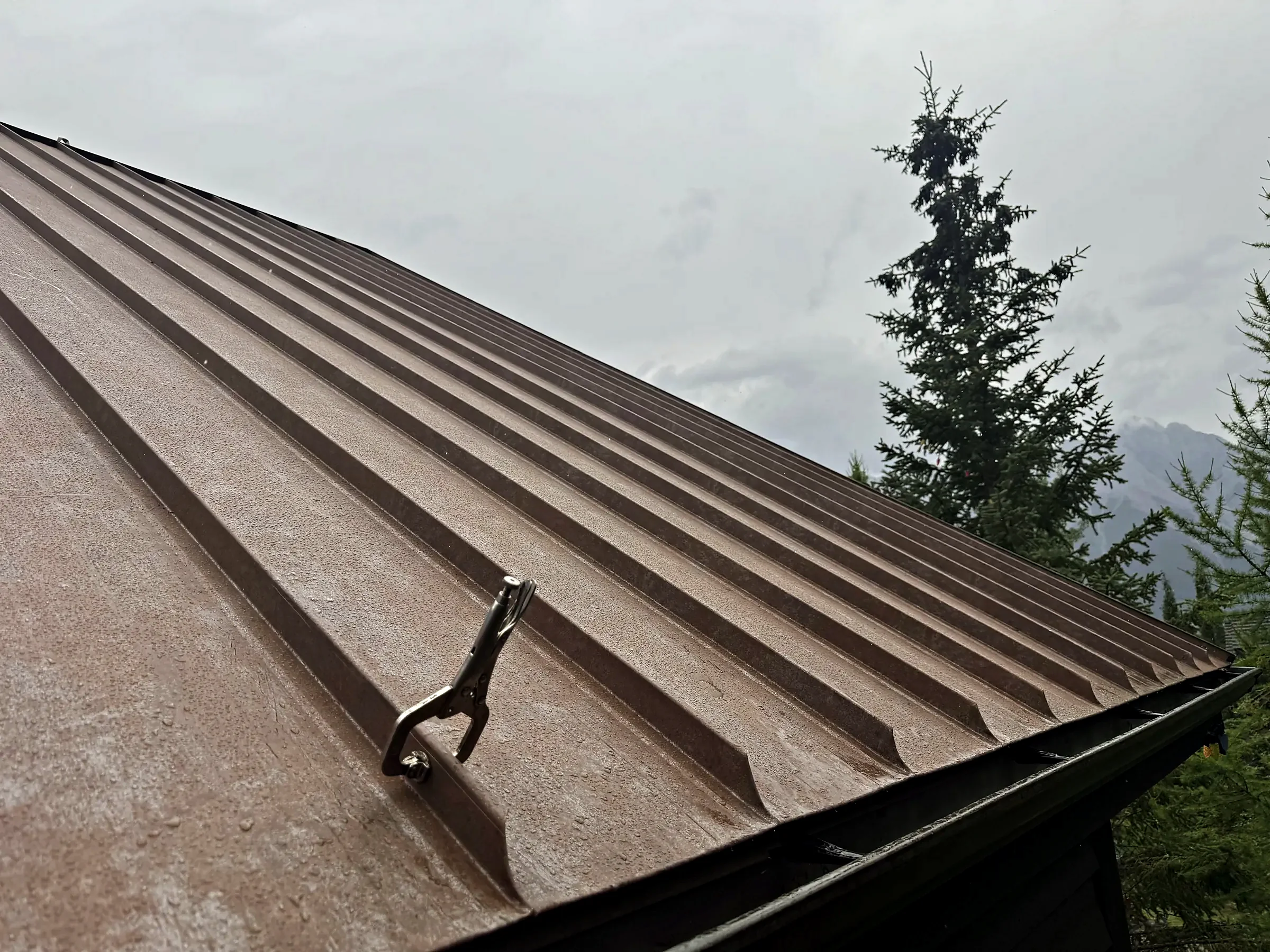
Standing seam roofing keeps the primary panel connection raised above the surface where water travels. Exposed screws punched through the face of the panel are the leading failure point on exposed-fastener metal roofs. Standing seam panels avoid this by interlocking at vertical seams, with fasteners or clips hidden inside the seam, out of the water path entirely.
That raised seam creates a continuous, unbroken plane for water to sheet down toward the eaves. The seam is only one part of the system, though. Valleys, flashings, penetrations, ridges, eaves, and roof-to-wall transitions still have to be detailed correctly. A well-formed seam cannot compensate for a poorly flashed chimney elsewhere on the roof.

Snap-Lock vs. Double-Lock: what’s actually different
| Snap-Lock | Double-Lock | |
|---|---|---|
| How the seam closes | Male/female edges snap together by hand or with a light mallet | Panels are folded once on-site, then mechanically crimped a second time (180°), with a seaming machine or by hand |
| Tools needed on-site | Minimal: snap-together installation | A seaming machine (and hand seaming tools on detailed areas) and a trained crew |
| Typical minimum slope | We install it only at 4:12 or steeper | Can go much lower, down to flat roofs with parapets when the seams are soldered (zinc, copper) |
| Wind uplift resistance | Good, but the seam can loosen under repeated thermal cycling if not detailed well | Generally higher, because the mechanical crimp holds tighter under stress |
| Installation speed | Faster, with lower labor time | Slower, because of the seaming equipment and skill required |
| Best suited for | Steeper roofs with straightforward geometry | Low-slope roofs, high snow or wind exposure, complex rooflines |
The word “double” refers to the number of folds used to form the seam, not to a multiplier on waterproofing performance. A snap-lock seam and a double-lock seam are both capable of shedding water reliably when the slope, panel profile, and installation are right. Where they diverge is in how much margin for error each system can absorb, whether that is snow load, wind, thermal movement, or imperfect detailing, before water finds a way in.

Why does roof slope matter so much here?
Slope determines how long water sits on the seam versus how quickly it drains off.
- Steeper roofs (4:12 and up): water moves fast, seams see less standing moisture, and both snap-lock and double-lock systems perform well.
- Low-slope roofs (below 4:12): water and melting snow can sit on the surface far longer, and wind-driven rain can push water up against a seam instead of simply running past it. This is where the extra mechanical closure of a double-lock seam earns its keep. We regularly see snap-lock panels installed on 2:12 or 3:12 roofs that start leaking in the first winter.
Published slope ratings vary by manufacturer and panel profile, but our own rule is simple: snap-lock only at 4:12 or steeper, and double-lock for anything lower.
Where metal roofs actually develop water problems
The seam gets most of the attention, but in the field, most leaks trace back to details around the seam rather than the seam itself:
- Valleys
- Chimneys and skylights
- Roof penetrations (vents, pipes, mechanical curbs)
- Roof-to-wall transitions
- Ridge and eave terminations
- Flashings
A correctly formed seam cannot compensate for a poorly flashed valley or an improperly lapped transition. This is worth repeating, because it is one of the most common mistakes in a rushed or low-bid metal roof install: getting the seam right while skipping over the details around it. It is also why every metal roof we install goes over an ice-and-water shield membrane, as building code requires.
What about metal roofing in Calgary specifically?
Calgary roofs deal with a demanding combination of conditions: heavy snow load, freeze-thaw cycling, chinook-driven temperature swings of 20 to 30°C in a single day, and intense summer UV exposure. Metal panels expand and contract significantly across those swings, and a seam or clip system that is not designed for that movement will fatigue over time. That is why we use floating clips, which let each panel move with temperature, and seam heights of 1, 1.5 or 2 inches depending on the roof.
For Calgary projects, the choice between snap-lock and double-lock, along with clip spacing, panel profile, and underlayment selection, should be based on the specific roof’s slope, exposure, and geometry rather than on a generic “which is better” answer.
How long does a metal roof actually last?
There is no single lifespan that applies to every metal roof. Service life depends on:
- Base material and coating (steel, zinc or copper, and the paint system on painted steel)
- Panel profile and seam type
- Climate exposure
- Installation quality
- Ongoing maintenance and detailing
The material and paint are covered by the manufacturer’s warranty. A high-end panel with a poor install will typically fail years before a mid-tier panel that was installed correctly, which is why we back every roof we install with a 25-year workmanship warranty.
[ FAQ ]Is double-lock standing seam always better than snap-lock?
Not automatically, but it is the system we recommend. Double-lock offers more margin on low-slope, high-exposure, or complex roofs. On a straightforward roof at 4:12 or steeper, a properly installed snap-lock system can perform reliably.
Can snap-lock panels be used on a low-slope roof?
Not by us. We install snap-lock only at 4:12 or steeper. Below that, we use double-lock.
Does “double-lock” mean the roof is twice as waterproof?
No. It refers to the two-stage mechanical fold used to form the seam, not a multiplier on water resistance. The performance difference comes from the strength and tightness of the mechanical closure rather than any doubling of a waterproofing property.
What causes most metal roof leaks if the seams are done correctly?
In the field, most leaks originate at valleys, penetrations, flashings, and roof-to-wall transitions rather than at a properly formed seam.
How do I know which system is right for my roof?
It depends on your roof’s slope, geometry, and exposure to wind and snow. Send us your drawings or address, and we will recommend the system that fits your roof.
Tell us about your roof
Choosing between snap-lock and double-lock is not a generic decision. It depends on your roof’s slope, exposure, and design. Tell us about your project, and we will recommend the system that fits your roof rather than the one that is easiest to sell. We have worked with metal for 18 years.
Get in touch