
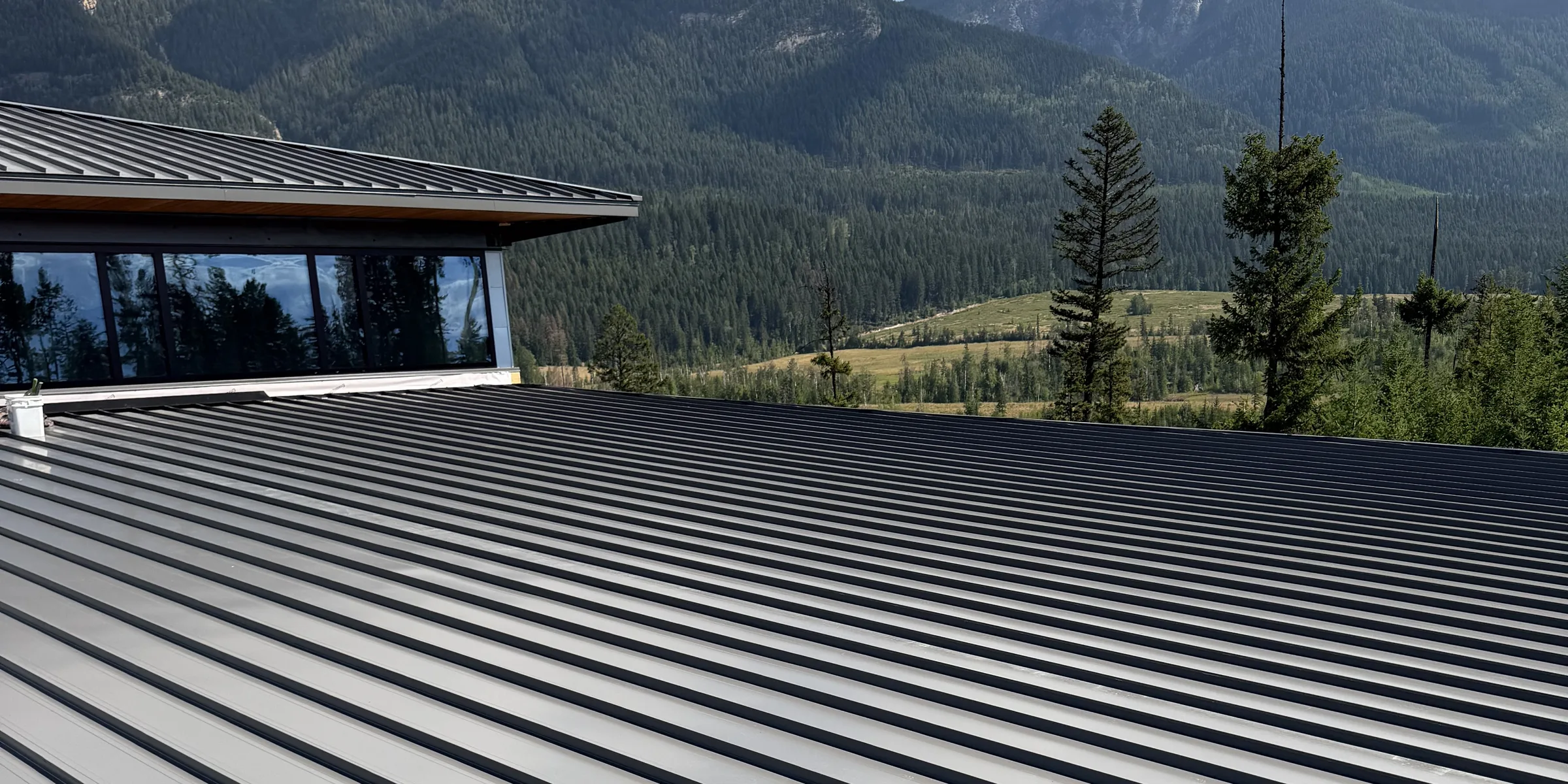
Quick answer
We install snap-lock standing seam only on roofs of 4:12 or steeper. Below 4:12, including 3:12 roofs, we use double-lock, and double-lock also works on flat roofs with parapets when the seams are soldered (zinc and copper). Slope matters because it decides how long water and melting snow sit on a seam. The seam sets the limit. On flat roofs the metal matters too, because only zinc and copper seams can be soldered. Below is how we choose the system, what changes on a low-slope roof, and what to put on the drawings.
[ Service ]Metal roofsDouble-lock standing seam steel for houses and cabins.See metal roofs →What does a 4:12 slope mean on a metal roof?
A 4:12 slope rises 4 inches for every 12 inches of horizontal run. A 3:12 roof rises 3 inches, a 2:12 roof rises 2. The lower the first number, the flatter the roof and the slower it sheds water. On drawings the slope is usually shown as this rise-to-run ratio, which is also how we talk about it.
Why does slope matter for a metal roof?
Slope decides how long water sits on a seam and how fast it drains off.
4:12 and steeper: water moves quickly, seams see less standing moisture, and both snap-lock and double-lock perform well.
Below 4:12: water and melting snow stay on the roof longer, and wind-driven rain can be pushed against a seam instead of running past it.
Calgary adds heavy snow load and freeze-thaw cycling, which keep low-slope seams wet for longer. That is why the seam type sets the minimum slope.
Snap-lock: 4:12 and steeper
Snap-lock panels close when the male and female edges are snapped together by hand or with a light mallet. The seam relies on its shape and sealant to resist water, which is why it needs a minimum slope.
Our rule is simple: we install snap-lock only on roofs of 4:12 or steeper, and only where the geometry is straightforward. It is faster to install, and on a steeper roof it performs reliably. We regularly see snap-lock panels put on 2:12 or 3:12 roofs that start leaking in the first winter.
Published slope ratings vary by manufacturer and panel profile. The 4:12 limit is our own rule.
Double-lock: below 4:12, down to flat
Double-lock panels are folded once on site and then crimped a second time, 180°, with a seaming machine or by hand. The result is a tighter, more weather-resistant closure that works on much lower slopes. Seam heights are 1, 1.5 or 2 inches depending on the roof, and the panels sit on floating clips so they can move with temperature.
On flat roofs with parapets, we still use double-lock. In zinc and copper the seams are soldered, which is what allows a double-lock seam to work on a flat surface.
The word "double" refers to the number of folds, not to twice the waterproofing. The real difference is how much mechanical force holds the seam closed and how low a slope it can handle. If your roof is 3:12, the answer is double-lock.
What changes on a low-slope or flat metal roof?
A lower slope leaves less margin for error, so the system and the details around it matter more.
Seam: double-lock only, never snap-lock below 4:12.
Flat roofs: double-lock with soldered seams in zinc or copper, with parapets. When zinc or copper is too expensive for the project, we sometimes use 26 gauge steel on a flat roof instead of our standard 24 gauge.
Underlayment: an ice-and-water shield membrane goes under every metal roof we install, as building code requires.
Details: most leaks start at valleys, penetrations, flashings and roof-to-wall transitions, not at a properly formed seam. A well-made seam cannot make up for a poorly flashed parapet or chimney.
Drainage: where water leaves a low-slope roof is a design decision, and it is best settled on the drawings.
Old roof: we never install metal over an old roof. It is removed first, and when it comes off the plywood underneath is rotten in roughly 8 out of 10 cases.
Why Calgary conditions raise the stakes
Metal roofs in Calgary deal with heavy snow, freeze-thaw cycling and chinook-driven temperature swings in a single day. Panels expand and contract across those swings, and a seam or clip system that cannot absorb that movement fatigues over time. That is why we use floating clips and choose the seam height, 1, 1.5 or 2 inches, for each roof. We install through the winter and only stop at around −30°C.
Snap-lock vs. double-lock by slope
| Snap-lock | Double-lock | |
|---|---|---|
| Minimum slope (our rule) | 4:12 or steeper | Below 4:12, down to flat roofs with parapets |
| How the seam closes | Edges snap together by hand or with a light mallet | Folded on site, then crimped a second time (180°) by seaming machine or by hand |
| Flat roofs | Not used | Soldered seams in zinc and copper |
| Installation | Faster, minimal tools | Slower, needs a seaming machine and a trained crew |
| Best suited for | Steeper roofs with straightforward geometry | Low-slope roofs, high snow or wind exposure, complex rooflines |
What to put on the drawings
For architects specifying a metal roof in Calgary and across Alberta, these points keep the slope and the seam consistent:
- Show the roof slope as a rise:run ratio on the elevations.
- Specify the seam by slope: snap-lock at 4:12 and up, double-lock below.
- Call out the seam height: 1, 1.5 or 2 inches.
- Specify floating clips so the panels can move with temperature.
- Note an ice-and-water shield over the whole deck.
- On flat roofs with parapets, specify double-lock with soldered seams in zinc or copper, and show the parapet and drainage details.
Send us the drawings and we will confirm the system against the actual roof.
[ FAQ ]What is the minimum slope for a metal roof?
It depends on the seam. We install snap-lock only at 4:12 or steeper. Below that we use double-lock, which works down to flat roofs with parapets when the seams are soldered (zinc and copper). Manufacturer ratings vary, so we follow our own rule.
Can you put a metal roof on a 3:12 slope?
Yes, with a double-lock seam. We do not use snap-lock on a 3:12 roof.
Can a metal roof be flat?
Yes. A flat roof with parapets takes a double-lock seam, soldered in zinc or copper.
Does a low slope mean a metal roof will leak?
No. A lower slope leaves less margin for error, so the seam type and the details around it matter more. Most leaks start at valleys, penetrations, flashings and wall transitions, not at a properly formed seam.
Does double-lock mean the roof is twice as waterproof?
No. "Double" refers to the two folds that form the seam. The difference is how tightly the seam is held closed and how low a slope it can handle.
Why not use snap-lock on a low-slope roof?
Because water and melting snow sit on the seam longer. We regularly see snap-lock panels on 2:12 or 3:12 roofs start leaking in the first winter.
Tell us about your roof
The right seam depends on your roof's slope, geometry and exposure. Tell us about your project and send drawings or the address, and we will recommend the system that fits your roof. We work in Calgary and surrounding areas, Canmore, and Golden, BC, and we have worked with metal for 18 years.
Get in touch